[VR] VR from Scratch: From Beginner to Full-Body Tracking - Based on Oculus Quest 2 - Part 1
Translated by AI from 中文 · View original
This post was recovered from Internet Archive snapshots; some images may be lost.
What Is VR
In Jargon
Virtual reality (English: virtual reality, abbreviated VR), also referred to as virtual technology or virtual environment, is the use of computers to simulate and generate a three-dimensional virtual world. It provides users with simulations of visual and other senses, making them feel as if they are personally present and able to observe things in the three-dimensional space in real time and without restrictions. When the user moves position, the computer can immediately perform complex computations and send accurate three-dimensional world imagery back to create a sense of presence. This technology integrates the latest developments in computer graphics, computer simulation, artificial intelligence, sensing, display, and parallel network processing, and is a high-tech simulation system generated with the assistance of computer technology.
--Excerpted from Wikipedia
In Plain English
VR is a new type of display device/technology that can give you a visual experience different from traditional monitors.
Its most intuitive manifestation today is a setup like this,
![Image]
Uses of VR
With it,
you can experience a low-spec version of <Ready Player One>
Image
and get up close and cuddly with these super-annoying idols,
Image Ranran 永雏塔菲 Genshin Impact
and achieve a true mutual love.
Admittedly, VR also has applications in science and engineering,
Image
but they are too far from ordinary people, and I lack the confidence to discuss them only in general terms here.
For ordinary people today, I think they can be summarized into two uses:
- Watching VR videos
- Playing VR games
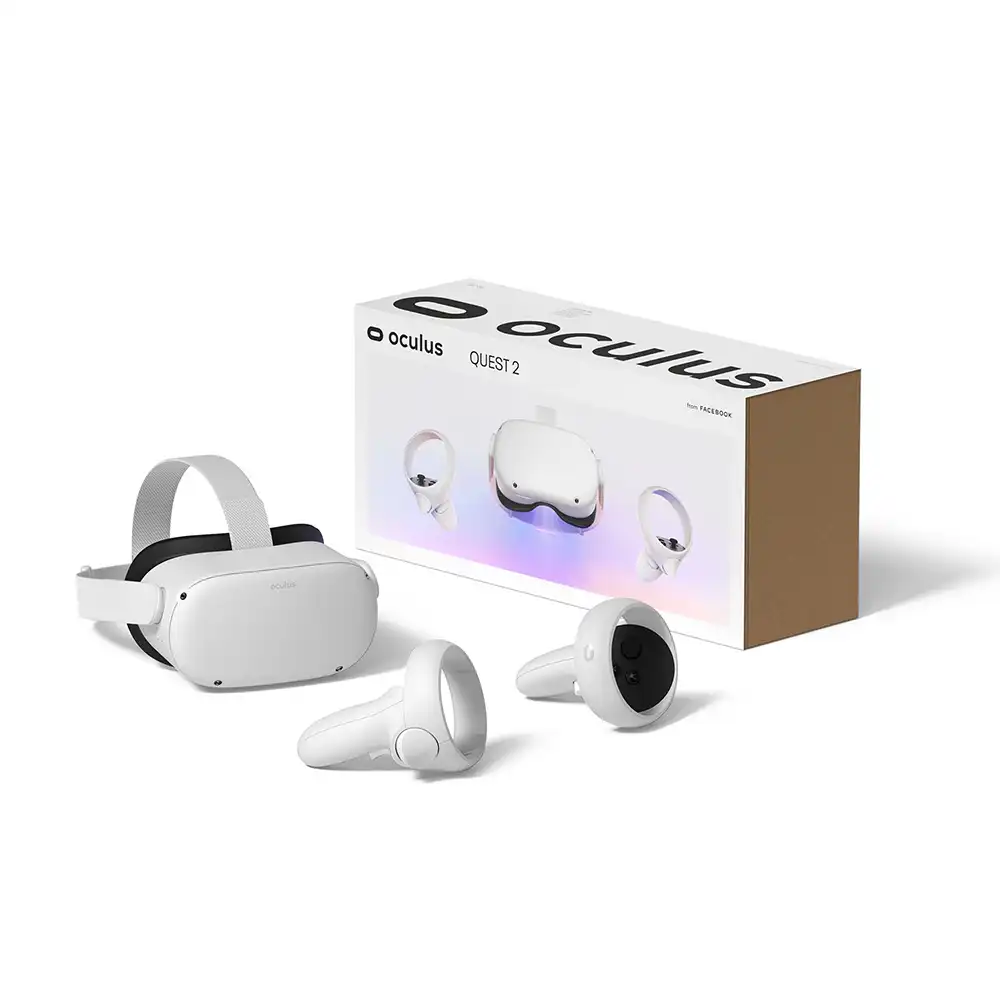
Oculus Quest 2
What Is It
Oculus is one of the world's top VR device manufacturers, having invested more than $15 billion cumulatively over the past five years in continuously developing new devices.
Quest 2 is Oculus's latest VR device currently on sale. In the two years since its release, its cumulative global sales have exceeded ten million, and it enjoys widespread praise.
In the following sections, it is abbreviated as q2.
It is currently the VR device with the best value for money, and will remain so for the next one to two years.
Why
To understand why q2 is the device with the best value for money, we first need to understand the two major camps of VR devices.
- PCVR and the outside-in tracking technology it uses
- Standalone VR and the inside-out tracking technology it uses
PCVR
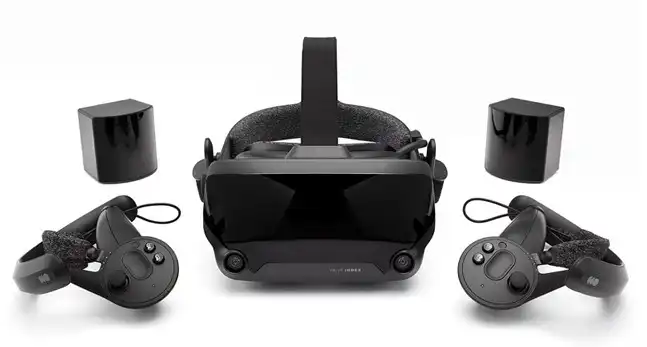
Valve Index is the representative player of PCVR
If you're a Steam user, you've surely come across its ads in some corner now and then.
- A flagship PCVR released by Valve in 2019
- Technically in cooperation with HTC, using a self-developed Lighthouse tracking system
- A representative work of outside-in tracking technology
- A well-balanced all-rounder, especially outstanding in its screen, with high refresh rate and low latency
- Also has features such as audio-based positioning and hand tracking, approaching an “esports” VR headset
Given the scope of this article, I won't dwell too much on its performance and specs here. To use a simple analogy that any Coolapk user can understand: Index is the Apple of VR devices—a tier of experience all its own, and a price tier all its own.
So, what is the cost?
- Expensive: the kit costs over 6,000 yuan, and adding some extra accessories pushes it past 10,000 yuan
- It is only a display; you also need an esports-grade PC to pair with it before you can use it. Note that this is not about getting the best experience—it is the entry-level standard
- Excellent tracking base stations require a fairly large real-world space to perform at their best.
- The monitor needs a cable to connect to the computer; it also needs a cable to connect to the computer, and the person needs to wear it while moving around, so you will see a scene like this,

Standalone VR
To make up for the four costs of PCVR, standalone VR was born
Standalone VR is essentially a phone. Take the Quest 2, which I am about to introduce: it uses Qualcomm's XR2, derived from the Snapdragon 865, as its SoC, assembled with a custom screen and VR lenses.
- The price is that of a phone
- No additional host is needed; it works out of the box
- A representative of inside-out tracking technology, requiring as little as 4 square meters of space for complete tracking
- Wireless use, except for charging
Goertek [002214] in China is the world's largest contract manufacturer of standalone VR, having taken all of Quest 2's orders. It also brought a new wave to domestic standalone VR.
Image iQIYI, PICO,
From the short primer above, it is not hard to see that standalone VR is more suitable to recommend to beginners. The cost of PCVR, often close to ten thousand yuan, is really hard to attract newcomers; it is mostly the choice of players who want to go further after experiencing the fun of VR.
But this also raises a new question: Quest 2 is only one corner of standalone VR. With domestic and other competing products available, why recommend it in particular?
Below I introduce a comparison between q2 and three other alternatives.
Comparison with Cheap Products
If you often browse Xianyu, you have probably seen some cheaper second-hand VR devices, such as Huawei Glass, Pico Goblin, and the like. Why not recommend these cheaper options to newcomers?
Just like thousand-yuan phones in the smartphone category, being able to hit a below-standard price inevitably comes with the absence of features (as deemed non-essential by the manufacturer).
But coincidentally, as a veteran bargain hunter, I have picked up a very cheap Pico Goblin and also tried a colleague's Huawei VR Glass. What they lack is precisely the most direct core sensory experience.
3DOF and 6DOF
DOF is a metric for measuring VR's expressive capability. It corresponds to a person's ability to move in reality.
- If you can turn your head and see things 360° around you, it is called 3DOF
- If on that basis you can also walk freely and change scenery as you move, it is called 6DOF
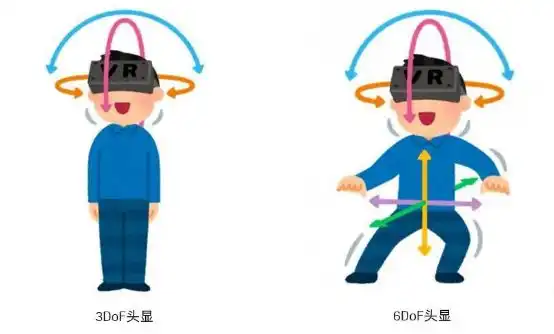
Thousand-yuan-phone VR generally has only 3DOF, meaning you can only sit and watch movies + play games with controller buttons. This is essentially no different from early simple boxes like Baofeng Mojing, only with some optimizations in apps and display.
An experience without free movement is destined to struggle to bring people enough novelty and fun.
Comparison with q1
Quest 1 is the previous generation of Quest 2, launched in 2019, with an SoC derived from the Snapdragon 835.
Because it cost $100 more, q1 was far stronger than q2 in screen and build quality.
Screen
q1 used an OLED screen from Samsung, which was far better than q2 in terms of immersion.
Build Quality and Feel
The q1 body uses fabric material; both in appearance and in hand it feels more refined than q2's plastic-heavy build.
Problems
The biggest problem is 835 versus 865. In 2022, it is basically the difference between “usable” and “smoothly usable.”
Comparison with Domestic VR
As mentioned earlier, Goertek's contract manufacturing also brought about domestic standalone VR brands.
Pico is a representative among them, backed by ByteDance.
Its latest model, Pico Neo 3, has exactly the same core components as Quest 2, and is also manufactured by Goertek.
But even with exactly the same hardware as q2, Neo 3 still cannot deliver the same user experience as q2.
Yes, VR devices also get a bonus from system optimization, and it accounts for a large proportion.
Stability
The most direct manifestation is in positioning and tracking when using VR, that is, the 6DOF experience mentioned earlier.
If q2's 6DOF is the iOS 15 system of 2022,
then Neo 3's 6DOF is Android 5.1 from 2015: a big improvement and usable, but still far behind iOS. Maybe one day it will develop to the level of Android 12 in 2022 and be able to compete with iOS, but not yet.
Ecosystem
Because Quest 2 is released for markets around mainland China, its market and ecosystem are many times larger than Pico's.
The most direct demonstration is that the Pico store has only 4 pages, while the Quest app store has 24.
Piracy
First, to state my position: I do not support piracy. I have also spent money on the Play Store and elsewhere.
But this is a real situation derived from the ecosystem problem.
As everyone knows, most cracking masters are abroad. Domestic sites such as 3DM and Youxia got their start by publishing cracked foreign works in the early years. Domestic “masters” are few in number.
The impact is the completely opposite result, despite the same heavily modified Android:
- q2 can install arbitrary pirated games and some offline pirated software
- Pico cannot install arbitrary pirated software
The games/software above all refer to paid games/software from the official store; ordinary third-party apps can be installed on both.
Pain Points of q2
Based on the above argument, I can conclude that q2 is a relatively good VR device for beginners. So, do I recommend buying it without thinking?
No. q2 is not perfect. The flaw does not come from the device itself, but from the company behind it.
The Stance Problem
Oculus's parent company Meta (Facebook) is indisputably an anti-China company.
At the top, Zuckerberg attacked China in the U.S. Congress.
At the bottom, on the Chinese internet there are countless posts about Facebook accounts being banned for no reason with nowhere to appeal.
In an era of globalization, and being something of a digital enthusiast, I cannot fully support only Chinese brands, but I fully respect and admire friends who practice this goal and are proud of it.
Network Problem
Because of FB's anti-China stance, it has almost no business within China, and Facebook is inaccessible in mainland China. But q2 uses exactly FB's account system; without an account, you cannot even activate it online.
This introduces the second problem—network.
Since this article will be posted on Coolapk, I cannot elaborate too much on this.
There are two solutions:
- The all-powerful Taobao or Xianyu: 50 yuan gets you the full set of services
- A soft router, or a special router that can be flashed with firmware such as Merlin or Padavan, represented by Newifi and Phicomm; they are very cheap on Pinduoduo.
Payment Problem
Still because of the FB problem, UnionPay cards cannot be used for purchases and payment settlement.
Solutions:
- Bank of China Mastercard debit card: free, no threshold, students can apply; recently it takes about two months to get the card
- A foreign-currency credit card from any bank
- PayPal, which requires paying about 15% in exchange-rate fees
Developer Problem
q2 uses a Qualcomm SoC, and of course its system is heavily modified Android, so the modding methods beloved by the vast number of Coolapk users can naturally be used as well. However, just like domestic manufacturers, identity verification is required to unlock modding eligibility.
PS: q2 is rather special; its developer options can be regarded as the BL lock of a smartphone.
The verification method is simple: just bind any payment method. But if the payment problem is not solved, this is also unsolvable here.
Where to Buy
Amazon Japan
Thanks to the sharp fall in the yen exchange rate, the Quest 2 on Amazon Japan has become cheaper and cheaper since the beginning of this year. The 128G entry version even costs less than 1,800 yuan.
But overseas shopping inevitably comes with uncertainties such as long delivery times, customs, and the pandemic. Coolapk friends need to learn about this themselves; direct shipping from Amazon Japan might be a little more convenient?
The entrance is in Amazon's overseas shopping WeChat mini-program.
Xianyu
Since Quest 2 is not sold domestically, even a brand-new version bought on Amazon Japan needs to be shipped overseas for repair during the warranty period. In this case, second-hand on Xianyu is a very good choice.
- Also without warranty; Taobao has no real price advantage, only adds uncertain merchant service
- VR has a high dust-collecting rate, so second-hand units are almost never in particularly bad condition
- VR is a niche product, so basically no unscrupulous Xianyu dealers are involved
Accessories
Lenses
Price: around 100 yuan
Specially for nearsighted people. Although you can play while wearing glasses, it is really uncomfortable.
Enhanced Head Strap
Price: around 100 yuan
The special design concentrates the force on the forehead. The official one is just a strap that tightens around the top of the head and the back of the head, which becomes very uncomfortable after playing for a while.
Carrying Case
Price: around 30 yuan
This is my personal recommendation. Most carrying cases are designed for enhanced head straps and are very unfriendly in size. When going out, switch back to the original head strap and pair it with this carrying case; it is very light and convenient.
Conclusion
This article briefly introduced what VR is, argued that Quest 2 is currently the most worthwhile VR device for getting started, and gave some advice along the way. My personal knowledge is shallow; thanks to the many articles on the internet, I was able to gain a superficial understanding of VR and Quest 2 and enjoy the fun within.
If there are any errors or omissions in the article, please do not hesitate to point them out.
Finally, here is a Quest 2 Chinese WIKI established by a big shot:
Quest 2 Chinese Guide
The next article will introduce how Quest 2 achieves the two uses I mentioned
- Watching VR videos
- Playing VR games
and some software, related usage methods, and extensions needed.
Stay tuned!
Thank you for reading as well, and I wish you a happy life!